CTR prediction, explained
A thumbnail score cannot predict your YouTube CTR
YouTube records impressions click-through rate after registered impressions reach real viewers. The same thumbnail can receive a different CTR when the audience, traffic source, title, or stage of distribution changes. A visual preflight can find creative problems before publishing. It cannot turn those missing conditions into a channel-specific percentage.
Compare ideas before publishing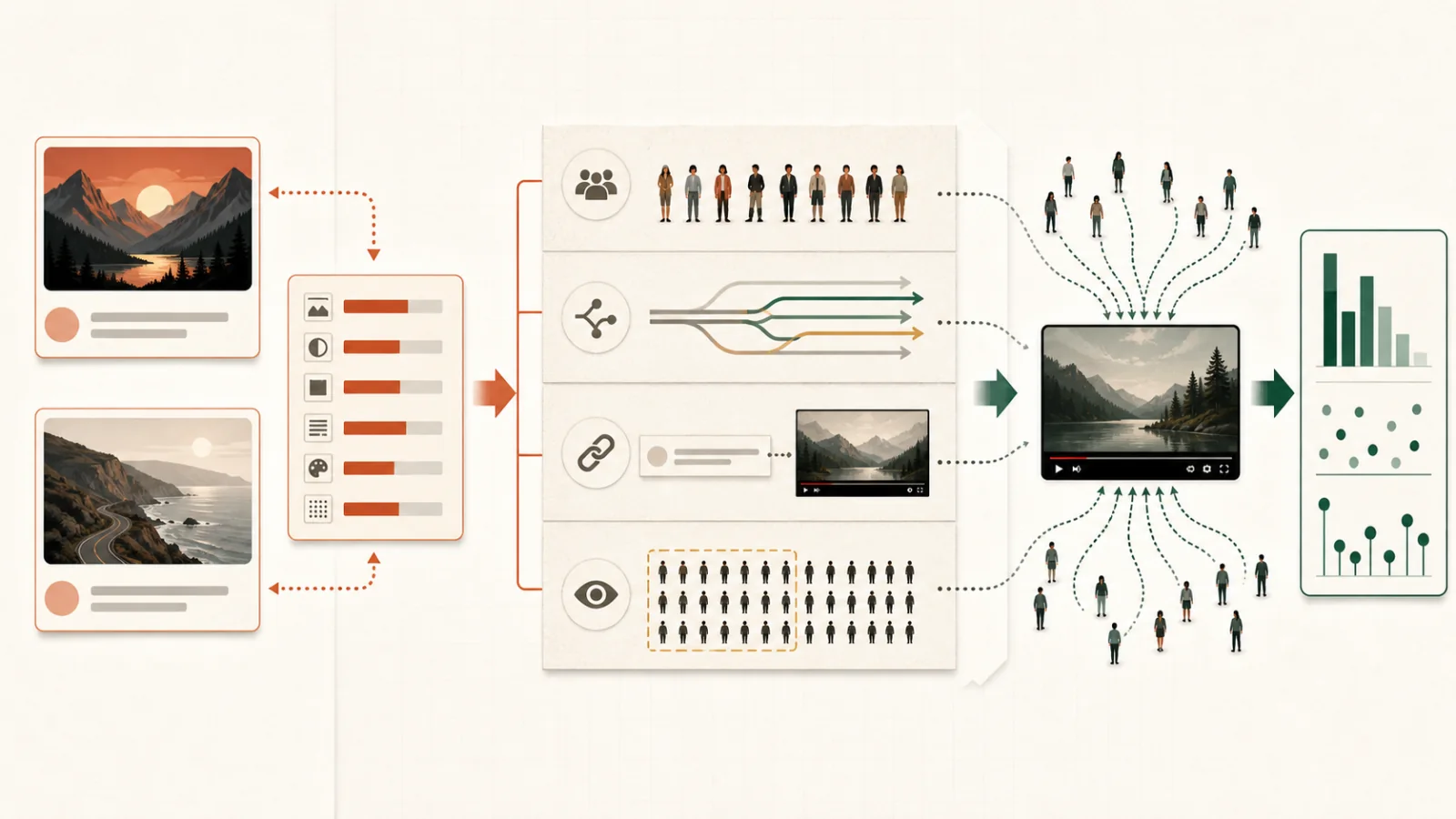
Observed behavior, not a design property
CTR exists only after an impression and a viewer response
YouTube defines impressions CTR as how often viewers watched a video after seeing its thumbnail in a registered impression. That rate describes what happened under a particular mix of viewers and surfaces. It is not a fixed property stored inside the image.
The missing inputs
Four conditions can change while the image stays the same
A predictor that sees only pixels is missing the conditions YouTube uses to record and distribute impressions.
Audience composition
Early impressions may reach people who already know the channel. Later impressions can reach less familiar viewers, and the rate can change even when the packaging does not.
Traffic surface
Search viewers arrive with a specific need. Home viewers are browsing among many options. YouTube says CTR can vary significantly across those surfaces.
Title and video promise
A thumbnail is shown with a title and competes with other videos. A visual-only analysis does not know whether the complete package fits the query, recommendation, or video itself.
What counts as an impression
YouTube does not count every place a thumbnail appears. External sites, email, notifications, and several other surfaces sit outside the registered-impression metric.
Use the right output
A preflight score and CTR answer different questions
Thumbnail AB Test does not train on your channel history, read YouTube Analytics, observe impressions, or simulate viewers. Its score is not a probability and should never be relabeled as predicted CTR.
| Thumbnail AB Test preflight | YouTube impressions CTR | |
|---|---|---|
| Question | Which option has fewer visible creative problems? | How often did viewers watch after a registered impression? |
| Inputs | The 2 to 6 images and titles in this comparison | Real impressions and viewer responses on YouTube |
| Output | A deterministic relative score and revision prompts | An observed rate in YouTube Analytics |
| Audience data | None | Your video's actual distribution |
| Safe use | Shortlist and revise before publishing | Review performance after publishing with context |
Use stronger evidence as it becomes available
Three decisions, three evidence levels
- 01
Before publishing
Remove avoidable creative problems
Compare 2 to 6 complete thumbnail and title packages. Check legibility, contrast, composition, title patterns, and the weakest signal. Keep no more than three finalists.
Run the preflight - 02
After upload
Let viewers compare the finalists
YouTube's native test accepts up to three titles, thumbnails, or paired combinations. It chooses by watch time share rather than CTR alone.
Follow the testing workflow - 03
After impressions arrive
Read the observed result in context
Use YouTube Analytics to inspect impressions, CTR, traffic source, and watch time. Early results may reflect a more familiar audience than later distribution.
Before trusting a percentage
Ask a CTR predictor five questions
A precise-looking number can still be the wrong measurement. The tool should explain where the estimate came from and how you could verify it.
What dataset connects the analyzed features to registered YouTube impressions and viewer responses?
Does validation cover channels, audiences, titles, topics, and traffic surfaces like mine?
Is the result calibrated as a probability, or is it a heuristic score with a percent sign?
Does the tool publish uncertainty and out-of-sample validation instead of one exact-looking number?
Can I compare the estimate with later YouTube Analytics without changing the definition of success?
Official YouTube references
YouTube can change metric definitions, analytics coverage, and testing behavior. This page uses the site's 90-day source review window.
Checked .
- YouTube: Decoding CTR and impressionsAudience expansion, traffic-source context, and why CTR should not be read alone
- YouTube: Check impressions and watch timeRegistered-impression coverage and the Analytics metrics available after publishing
- YouTube: A/B test titles and thumbnailsThree-option workflow and watch-time-share winner selection
CTR prediction questions
What a thumbnail predictor can and cannot tell you
Can AI predict a YouTube thumbnail's CTR?
A model can output an estimate, but that number is useful only if it is calibrated and validated for conditions like yours. A visual analyzer that has no access to your audience, title context, traffic source, or distribution cannot produce a channel-specific CTR forecast from the image alone.
What is a good YouTube impressions CTR?
There is no single target that fits every video. YouTube says CTR varies with audience and traffic source, and it can fall as a video reaches a broader audience. Compare the rate with impressions, source mix, watch time, and your own relevant history.
Does a high thumbnail score mean a high CTR?
No. Thumbnail AB Test ranks the options in one comparison with fixed visual and title rules. It does not observe registered impressions or viewer responses, so the score is neither CTR nor a probability of a click.
Does YouTube's native A/B test choose the highest CTR?
No. YouTube says its native test chooses the option with the highest watch time share. CTR can be part of performance, but the experiment does not select a winner from CTR alone.
When should I check CTR after publishing?
YouTube says Analytics data can become available within a few hours. Treat an early reading as partial evidence because the first viewers may know your channel better than the later audience. Keep the traffic source and impression volume beside the rate.
What can I do before publishing if CTR cannot be known yet?
Compare complete thumbnail and title packages, remove legibility and composition problems, and keep distinct finalists. After upload, use YouTube's native test for viewer evidence and Analytics for the observed CTR in context.
Choose the evidence you need
Fix the package first, then measure viewers
Use the Tool for relative preflight, Methodology for the exact scoring boundary, or the workflow guide for live audience validation.
You cannot know the rate yet. You can still improve the choice.
Compare complete thumbnail and title options, find the weakest signal, and save real audience traffic for the finalists.